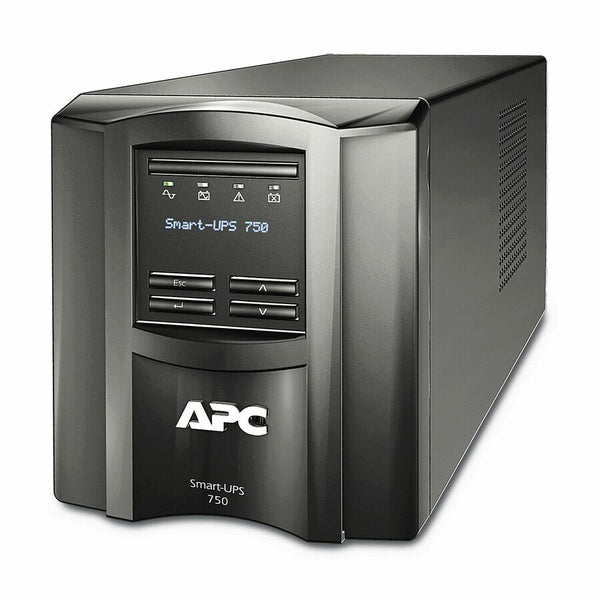
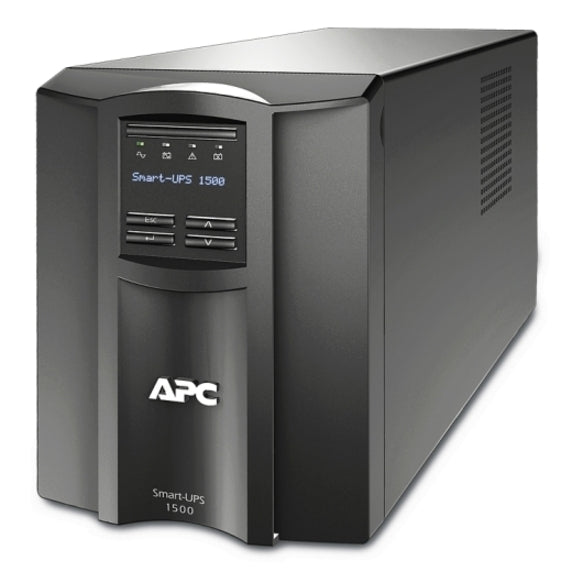
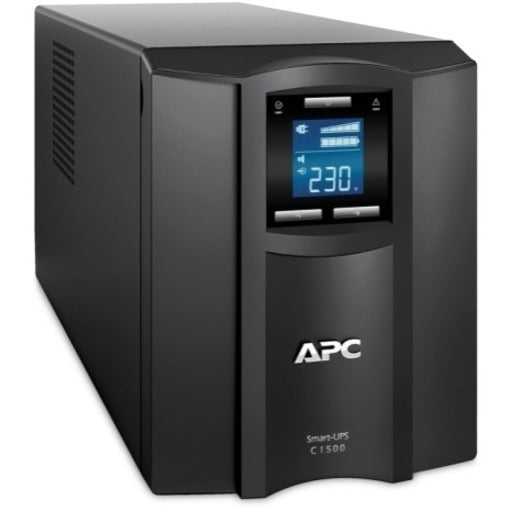
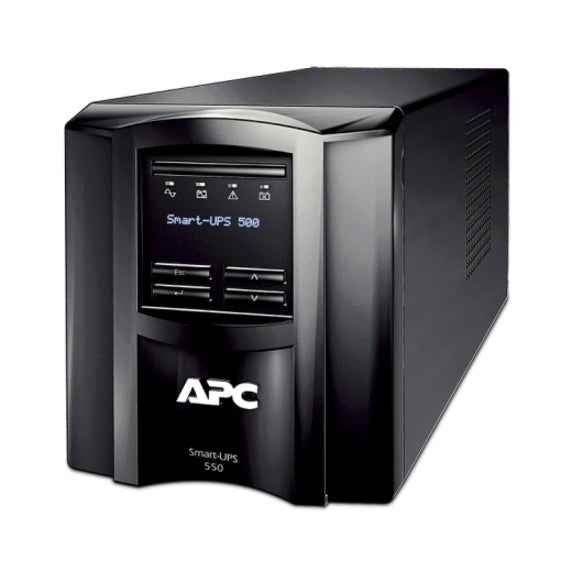
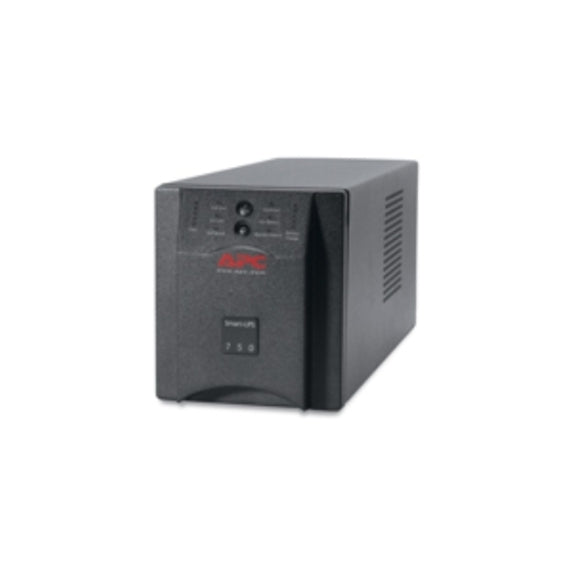
What is APC Smart-UPS?
APC Smart-UPS is the business-grade line-interactive and double-conversion online family from APC by Schneider Electric — the default specification for server rooms, IT closets, and mid-market edge deployments worldwide. The range spans roughly 750 VA at the entry end through to 10 kVA at the top of the Smart-UPS SRT platform, covering every typical SMB and mid-enterprise workload with pure sine wave output, AVR, PowerChute integration, and full network management.
Compared to the entry-level APC Back-UPS line, Smart-UPS is the minimum specification for any server or networking load: pure sine wave output (active-PFC power supplies will reject the simulated sine wave that Back-UPS units produce), longer warranty (three years electronics / two years battery as standard), and deeper PowerChute integration with VMware, Hyper-V, and Linux. See our full APC UPS collection for the broader catalog including Back-UPS, Symmetra, and Galaxy.
Smart-UPS product lines explained
APC splits Smart-UPS into distinct model prefixes. Each prefix signals topology, form factor, and voltage class. The table below maps every current Smart-UPS line to its intended use.
For most SMB rack buyers, the shortlist is the SMT line (line-interactive, rack or tower, LCD display, 750 VA–3000 VA) or the SMX line when extended runtime is needed. The SRT line is the specification for medical, VoIP, and critical edge — anywhere the 2–4 ms line-interactive transfer is unacceptable. The SRTL Smart-UPS Ultra platform is the new-generation pick for dense 2U deployments where lithium-ion's 10-year service life offsets the higher entry cost.
Smart-UPS spec reference
Flagship SKUs across the most commonly purchased Smart-UPS configurations:
How to choose the right Smart-UPS
Sizing: VA and wattage
Every Smart-UPS is rated in both volt-amps (VA) and watts (W). Legacy SMT units typically run a 0.6 power factor — a SMT1500 delivers 1500 VA but only 1000 W. Current unity-PF Smart-UPS Ultra (SRTL) and Smart-UPS SRT 6/8/10 kVA models deliver VA equal to watts. Modern IT loads draw close to unity PF, so check wattage, not just VA. Add up nameplate watts, multiply by 1.25 for growth, and pick a UPS whose watt rating exceeds that number. Our UPS sizing guide walks through the full method.
Topology: line-interactive or online
Line-interactive (SMC, SMT, SMX) is the right topology for 80% of SMB server, networking, and POS loads — 2–4 ms transfer, AVR, lower cost. Online (SRT, SRTL Smart-UPS Ultra) is required for medical equipment, VoIP PBX, precision lab gear, and any load that can't tolerate brief transfer gaps. Read line-interactive vs online UPS for the decision criteria.
Form factor
SMT and SMX ship in tower, 2U rack, and rack/tower convertible. SRT models are all rack/tower convertible. SRTL Smart-UPS Ultra is a 2U short-depth chassis that can also wall-mount or ceiling-mount, making it the pick for retail back-of-house and edge deployments where rack space is tight.
Replacement batteries
Every Smart-UPS uses the APCRBC naming convention. The cartridge part number is printed on the unit label and listed in the user manual. Common cartridges: APCRBC124 (SMT2200/SMT3000 family), APCRBC123 (SMT750 family), APCRBC133 (SMT1500), APCRBC140 (Smart-UPS SRT 5/6 kVA). See the full APC RBC batteries collection for the complete matrix.
Installation and warranty
Every APC Smart-UPS sold by UPSPLUSBATTERY.CA ships from a Canadian warehouse with full manufacturer warranty — three years electronics and two years battery on SMT/SMX/SRT, five years on Smart-UPS Ultra (SRTL). Our team handles pre-sales sizing, RMA coordination, and commissioning questions. Units at 3 kVA and below plug into standard NEMA receptacles; 5 kVA and above on SRT typically require hard-wire input completed by a licensed electrician per CSA.
Frequently asked questions
What is the difference between Smart-UPS and Back-UPS?
Back-UPS is entry-level: standby topology, simulated sine wave on most models, no AVR, shorter warranty. Smart-UPS is business-grade: line-interactive with AVR, pure sine wave output, LCD, PowerChute integration, three-year electronics warranty. If you are protecting any active-PFC power supply (servers, modern workstations, many NAS units), Smart-UPS is the minimum specification.
What does the model number suffix mean?
Smart-UPS model suffixes encode region and features. RM = rackmount. I2U = 2U rack chassis with IEC outlets. NC = pre-installed network management card (AP9641). X = extended runtime. LCD = LCD display. HV = 208/230/240 V. LV = 120 V. So SMT1500RMI2UC decodes as Smart-UPS, 1500 VA, rackmount 2U, IEC outlets, C-suffix 120 V variant.
Which Smart-UPS model is most popular in Canada?
The SMT1500RM2UC (1500 VA / 1000 W, 2U rack, NEMA 5-15 plug) is the single most deployed Smart-UPS in Canadian server closets — it fits standard 19-inch racks, covers one or two 1U servers plus a switch, and takes the widely-available APCRBC133 replacement cartridge.
Do Smart-UPS units support external batteries?
SMX and SRT models accept external battery packs for extended runtime. An SRT1500RMXLI plus a SRT48BP delivers roughly 25 minutes at full load versus 11 minutes stock. SMT units do not support external batteries — if you need extended runtime in the SMT VA range, step up to the equivalent SMX unit.
How long does a Smart-UPS battery last?
APC rates Smart-UPS sealed lead-acid batteries for three to five years in a climate-controlled environment (20–25 °C). Smart-UPS Ultra (SRTL) lithium-ion batteries are rated for ten years. PowerChute flags the battery once impedance crosses the threshold.
Can I replace the Smart-UPS battery myself?
Yes, on every current Smart-UPS model. The cartridge is hot-swappable — the UPS continues to protect the load during the swap. Use the APCRBC number listed on the unit label and reset the install date via the front-panel LCD.
Do Smart-UPS units come with a warranty?
Yes. Three years electronics and two years battery as standard on SMT, SMX, and SRT. Five years on Smart-UPS Ultra (SRTL) including both electronics and lithium-ion battery. Warranty claims are handled directly by Schneider Electric (APC) and its authorized service network; UPS Plus Battery is an independent reseller and does not perform warranty service.

 In stock